ResourcesCompany Update
Brazilian Rare Earths (ASX: BRE) Maps US$7.9 Billion Project
Brazilian Rare Earths has outlined a US$7.9 billion after-tax NPV for Rocha da Rocha. The preliminary study requires US$969 million upfront and targets 2031 production.
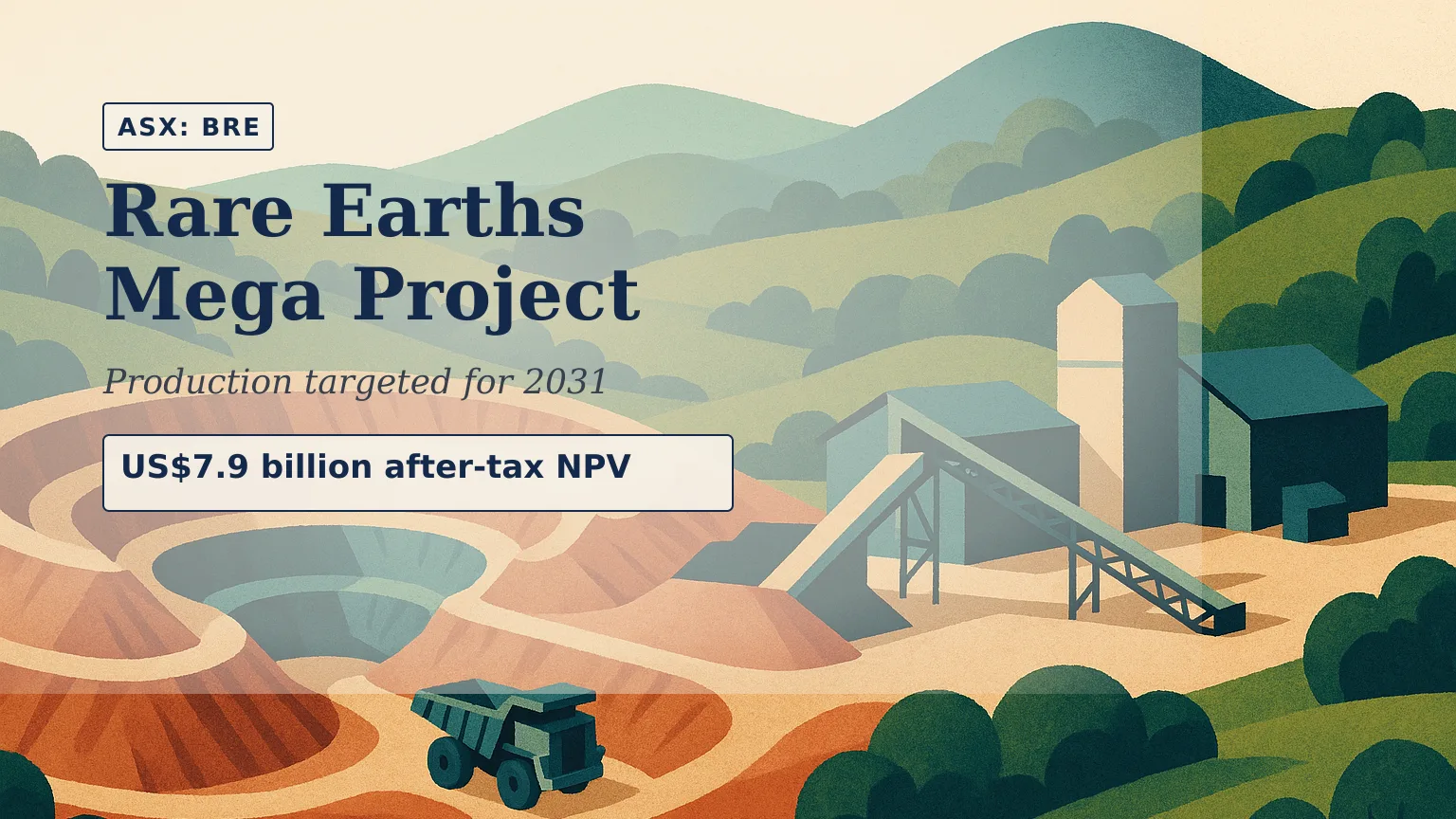
Brazilian Rare Earths has outlined a US$969 million development for its Rocha da Rocha rare earths project in Bahia, Brazil.
The preliminary study targets integrated production from 2031 across a 14-year operating life. Under the Argus European and US forecast case, after-tax net present value reaches US$7.9 billion.
The same case produces an 89% internal rate of return and a 1.1-year payback period. Life-of-mine annual EBITDA averages US$1.37 billion, while operating free cash flow averages US$1.19 billion.
High Grade Drives the Model
Monte Alto provides the initial feed and anchors the project’s forecast cost position. Its primary and residual Mineral Resource averages 11.3% total rare earth oxides.
That grade allows smaller feed volumes and simpler mine-site processing. Dry crushing, screening and sensor-based sorting would reject about half the feed mass.
Upgraded material would then travel to the planned Camaçari refinery. The industrial complex offers existing utilities, chemical supply chains, logistics and skilled labour.
Benchmark Mineral Intelligence places Rocha da Rocha at about US$21 per kilogram of neodymium-praseodymium equivalent. That represents the lowest forecast cost among Western projects on its 2032 curve.
Heavy Rare Earth Exposure
The study forecasts annual production averaging 5,276 tonnes of neodymium-praseodymium oxide over the project’s life. It also forecasts 2,253 tonnes of heavy rare earth concentrate annually.
That concentrate would contain about 207 tonnes of dysprosium and 40 tonnes of terbium each year. Forecast annual yttrium output averages 989 tonnes.
These elements serve permanent magnets, robotics, defence systems, electric vehicles and advanced manufacturing. Heavy rare earth supply remains particularly concentrated in China-linked supply chains.
Carester has a binding 10-year offtake covering concentrate containing up to 150 tonnes of dysprosium and terbium annually. Production outside that volume or term will require further commercial arrangements.
Preliminary Economics Carry Material Risks
The study has an intended accuracy of plus or minus 40%. Its production target comprises 44% Indicated and 56% Inferred Mineral Resources.
No Ore Reserves have been declared. Inferred Resources carry lower geological confidence and cannot support Reserve estimation at this stage.
However, early production is weighted toward higher-confidence material. Indicated Resources comprise about 93% of scheduled processing feed in year one and 87% across the first five years.
Development funding has not been secured. BRE held about A$135 million in cash at June 30, compared with the US$969 million upfront requirement.
Development Options
The company will now advance pre-feasibility work, permitting, resource conversion, process optimisation and product qualification. A final investment decision is targeted for mid-2029.
BRE is also evaluating earlier concentrate sales from Monte Alto. That pathway carries indicative upfront capital of US$91 million and could begin in 2030, subject to further work.
No value from early concentrate sales is included in the base economics. Uranium, scandium, niobium, tantalum and titanium revenue is also excluded.
Latest BRAZILIAN RARE EARTHS LIMITED ASX Announcements
- 30 Sept 2026 · 9:15 amCompany Update
- 11 Sept 2026 · 9:21 amCompany Administration
- 8 Sept 2026 · 9:30 amCompany Update
- 4 Sept 2026 · 5:10 pmOther
- 28 Aug 2026 · 11:02 amFinancial Results
- 26 Aug 2026 · 8:36 amCompany Update
- 25 Aug 2026 · 5:04 pmSubstantial Holders
- 18 Aug 2026 · 10:01 amPresentations
![[ASX: BRE] BRAZILIAN RARE EARTHS LIMITED a diamond drill rig operating in the Bahia countryside, framed from a low wide angle with](/media/hero/19377c9b-01a1-43e8-a57e-47c9deb7da7e/1790756998796-214482cc-640w.webp)
![[ASX: BRE] BRAZILIAN RARE EARTHS LIMITED inside a modern Brazilian mineral-processing pilot plant, technicians monitor flotation cells, pumps and slurry tanks as](/media/hero/dacf7e46-4c11-41d4-9ded-0255b5c9b7b1/1788835870844-5f9ad9a7-640w.webp)
![[ASX: TNC] TRUE NORTH COPPER LIMITED a diamond drill rig operating on the dry, sparsely vegetated terrain of northwest Queensland, framed widely](/media/hero/5f4af128-b442-40ef-8015-adbacbb70125/1790747350682-36e47125-640w.webp)
![[ASX: SLS] SOLSTICE MINERALS LIMITED a wide aerial view of multiple drill rigs operating across flat, sparsely vegetated Western Australian Goldfields terrain,](/media/hero/0ef30aa2-5c4c-4180-8bbf-7fb77c962fc9/1790761598131-40ffbe4b-640w.webp)
![[ASX: TMX] TERRAIN MINERALS LIMITED a reverse-circulation drill rig operating in the arid Murchison landscape of Western Australia, shown in a wide](/media/hero/1b7ce700-3b2f-4848-8ac4-e4772a07f834/1790760983010-4dee7285-640w.webp)
![[ASX: AYA] ARTRYA LIMITED a radiologist and cardiologist reviewing coronary CT images and a three-dimensional coronary artery model on medical workstations inside](/media/hero/81ef03e1-02fb-492f-b4d5-a8cb1b56a72d/1790900297914-3627b902-640w.webp)
![[ASX: VBS] VECTUS BIOSYSTEMS LIMITED a biotechnology researcher in a laboratory examining lung-tissue samples beside analytical instruments, framed with the scientist in](/media/hero/e3d1b8a7-7778-416b-aec3-c04f105c749e/1790749714634-0e371c85-640w.webp)
![[ASX: APA] APA GROUP a large gas peaking power station under construction in regional Queensland, with turbine buildings, cranes and crews spread](/media/hero/7961b369-aefd-47fe-b9e1-e372ef5fad78/1790757621985-c39f2808-640w.webp)