Health CareCompany Update
EMVision Medical Devices (ASX: EMV) Advances Regional Stroke Study
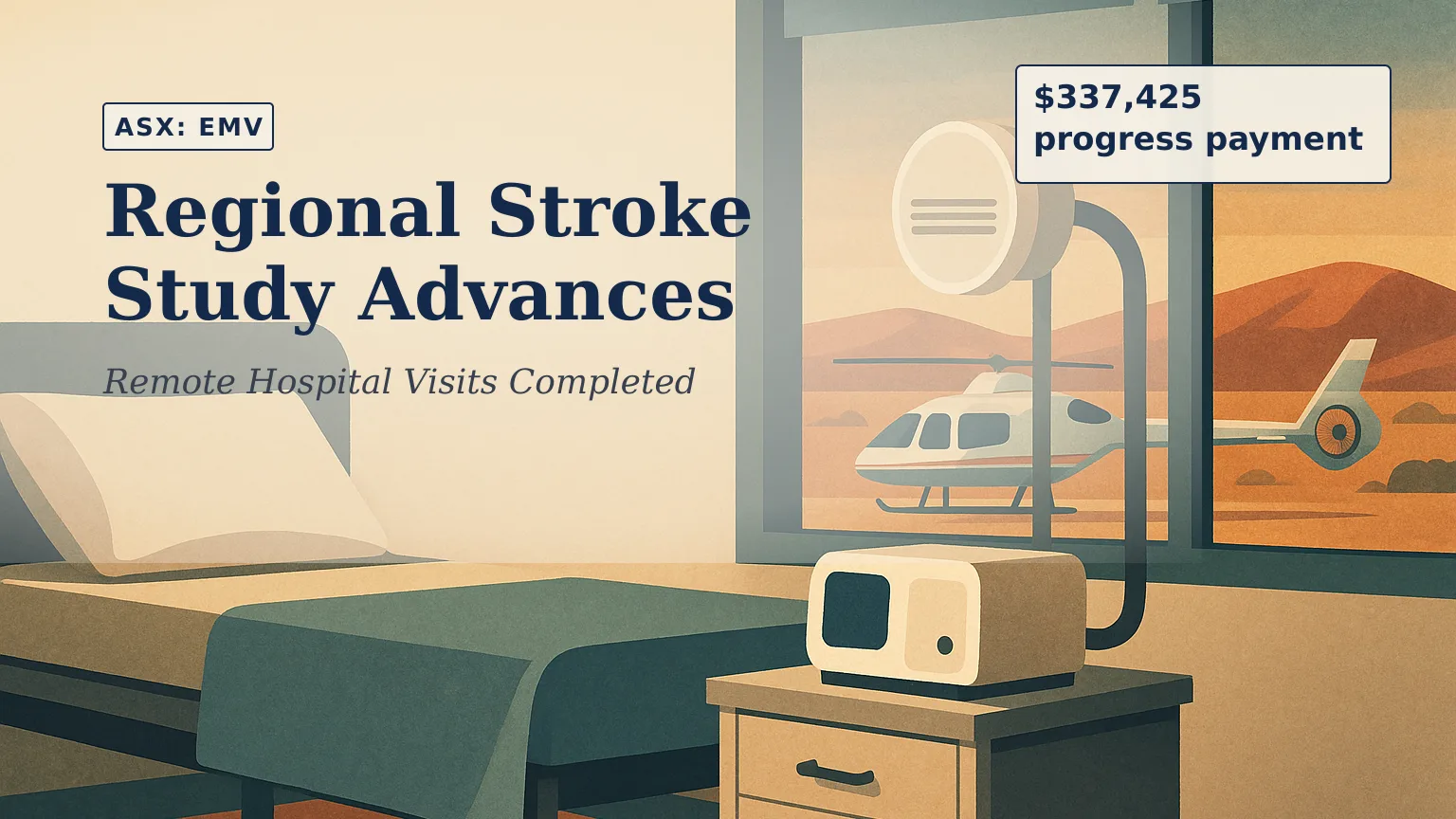
EMVision has completed remote hospital site visits and received a $337,425 progress payment. Its study will assess the emu brain scanner in regional stroke care.
Listen to article
0:00 / 3:27EMVision Medical Devices has completed two remote hospital site visits and received a $337,425 government-funded progress payment. The work advances preparations for its Regional Benefits Study of the emu bedside brain scanner.
The South Australian study will be the first to evaluate the device’s benefits in clinical use. It targets hospitals where suspected stroke patients must travel elsewhere before receiving a confirmed diagnosis.
Building a Remote-Care Workflow
Both visited emergency departments operate nurse-led assessment models without on-site computed tomography, or CT. Medical support also varies between the locations.
One hospital is about eight hours by road from the nearest comprehensive stroke centre. The journey takes around 1.5 hours by air.
EMVision and local staff examined how an emu scan could fit into emergency assessment, telestroke consultations and patient retrieval. The company is also working with South Australia’s telestroke service on the proposed workflow.
Following protocol finalisation, EMVision intends to provide scan results through telehealth. A consulting stroke neurologist would then access them during the standard consultation.
The study is designed to assess whether moving diagnostic capability closer to patients can accelerate time-sensitive decisions. That evidence could support clinical adoption where CT access is limited or unavailable.
Funding and Approvals
The $337,425 payment was received in August under the Australian Government’s Cooperative Research Centres Projects program. Project partners include the Australian Stroke Alliance, Titan Pre-Hospital Innovation and South Australia’s Rural Support Service.
However, the study still requires several preparatory steps. These include protocol finalisation, ethics approval, site contracts and research governance approvals. EMVision is also considering additional sites.
Stroke can result from either a blocked blood vessel or bleeding in the brain. Those stroke types require different care, making rapid diagnosis central to treatment decisions.
Relevance Beyond Australia
EMVision said the regional opportunity begins with about 400 rural, regional and remote Australian hospitals. It also pointed to more than 1,300 US Critical Access Hospitals with comparable diagnostic challenges.
These federally designated US hospitals have no more than 25 beds and provide round-the-clock emergency care. They are also located more than 35 miles from another hospital.
According to the announcement, only 56% of US states have some CT imaging available at every Critical Access Hospital in that state. Even where CT exists, continuous technologist coverage is not assured.
Advanced imaging needed to identify acute ischaemia can also be unavailable. EMVision has previously identified about 330 Critical Access Hospitals in the US “Stroke Belt” as high-priority initial launch targets.
The company said these hospitals receive Medicare reimbursement at 101% of reasonable costs. EMVision believes this model may reduce equipment-adoption barriers when clinical and operational benefits are demonstrated.
Chief Executive Officer Scott Kirkland said: “This study is designed to show the benefit of moving the diagnosis to the patient, speeding up time-sensitive clinical decisions, starting in some of the most remote hospitals in Australia, with clear relevance to rural America.”
Latest EMVISION MEDICAL DEVICES LTD ASX Announcements
- 29 Sept 2026 · 8:58 amMeetings & Governance
- 28 Sept 2026 · 8:45 amCompany Update
- 16 Sept 2026 · 9:02 amCompany Update
- 11 Sept 2026 · 2:15 pmSecurities Administration
- 3 Sept 2026 · 8:48 amCompany Update
- 31 Aug 2026 · 8:28 amCompany Update
- 24 Aug 2026 · 9:19 amFinancial Results
- 24 Aug 2026 · 9:13 amCompany Administration
![[ASX: SNT] SYNTARA LIMITED a clinician observing a clinical trial participant walking along a marked assessment path in a neurological examination room,](/media/hero/90bb9bfc-0b2a-4775-908d-ec1fad35eb0f/1791336817954-71a1eaf0-640w.webp)
![[ASX: DVL] DORSAVI LTD a humanoid robot beside a person wearing compact movement sensors in a biomechanics testing space, framed widely to](/media/hero/164b27bc-b923-4d00-ad47-e7f689f9663f/1791264301015-adc3f600-640w.webp)
![[ASX: AYA] ARTRYA LIMITED a radiologist and cardiologist reviewing coronary CT images and a three-dimensional coronary artery model on medical workstations inside](/media/hero/81ef03e1-02fb-492f-b4d5-a8cb1b56a72d/1790900297914-3627b902-640w.webp)
![[ASX: CAE] CANNINDAH RESOURCES LIMITED a diamond drill rig operating on rugged terrain at the Mt Cannindah exploration project in central Queensland,](/media/hero/6233c7ea-bcc3-4e6f-88c9-df0e823462a4/1791937391598-3848559c-640w.webp)
![[ASX: CCM] CADOUX LIMITED a close-up of unbranded cylindrical lithium-ion cells moving through an automated battery manufacturing line, with robotic equipment handling](/media/hero/351fae87-0e95-4e1b-a3f0-6191476cdaba/1791936952935-66cfba65-640w.webp)
![[ASX: FRI] FINBAR GROUP LIMITED a wide elevated view of the completed twin-tower Garden Towers development beside Queens Gardens, with the apartment](/media/hero/fa3e1003-44f7-4bd4-b22e-2350fa245c44/1791940379093-e4f9d193-640w.webp)