ResourcesCompany Update
QMines (ASX: QML) Hits Broad Copper-Gold Zone Beneath Mt Chalmers Pit
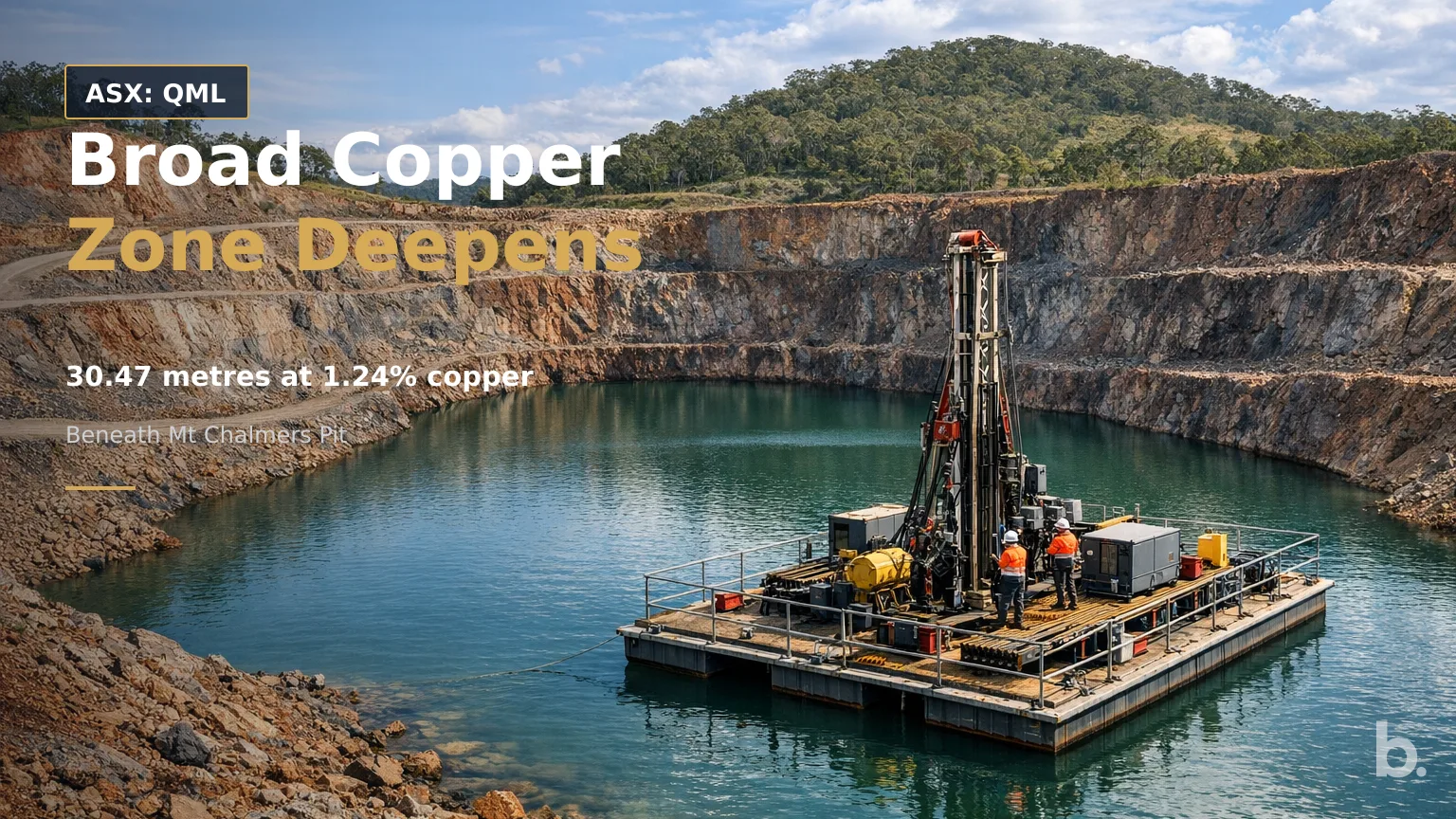
QMines has intersected 30.47 metres at 1.24% copper beneath the Mt Chalmers pit floor, its strongest pontoon copper result to date.
Listen to article
0:00 / 2:59QMines has reported its strongest copper intersection from the Mt Chalmers pontoon drilling program, with a broad mineralised interval beginning immediately beneath the floor of the historical open pit.
Hole 26MCDD053 returned 30.47 metres at 1.24% copper, 0.87 grams per tonne gold, 12.2 grams per tonne silver and 1.11% zinc from 42.53 metres. That included 9.47 metres at 2.36% copper, 2.14 grams per tonne gold and 1.51% zinc.
The vertical hole was drilled from a barge on the pit lake and passed through 37 metres of water and 4.9 metres of rubble and voids before reaching bedrock. Mineralisation was present in the first sample below the old pit floor and the intersection was broader than nearby pontoon holes.
On a width-by-copper-grade basis, QMines ranked the result as its strongest pontoon intersection and fourth-strongest copper intersection of the 2026 program. True widths of the in-situ intersections are not known.
The result will be assessed against the existing Mt Chalmers resource model. The project currently contains an 11.3 million-tonne Mineral Resource grading 0.75% copper and 0.42 grams per tonne gold, including measured, indicated and inferred material. Its Ore Reserve stands at 9.6 million tonnes grading 0.65% copper and 0.48 grams per tonne gold.
Copper continues to end of hole
A separate hole east of the pit, 26MCRD004, intersected 8.6 metres at 1.11% copper from 133 metres to the end of the hole, including one metre at 6.02% copper.
The hole sits between two of the strongest copper intersections reported during the 2026 program. It was abandoned at 141.6 metres after the drill rods became stuck, with the final sample still grading 0.59% copper. Mineralisation below that point remains untested, although the result does not establish continuity beyond the end of the hole.
Other results included 15 metres at 0.49% copper in hole 26MCDD018 and four metres at 5.03% zinc and 3.28% lead in hole 26MCDD009. Five of the 11 in-situ holes covered by the announcement returned only narrow, low-grade intervals or no significant intercepts.
Stockpiles offer a separate testwork opportunity
Drilling through historical stockpiles also identified copper, gold, silver and zinc in material outside the existing Mineral Resource and Ore Reserve. One hole returned eight metres at 0.33% copper, 0.31 grams per tonne gold and 0.90% zinc, while recomposited results from an earlier hole included 13 metres at 0.88 grams per tonne gold in historical fill. However, the reverse-circulation holes were widely spaced and sample recovery through loose fill was variable.
The company plans volume surveys, bulk-density measurements and metallurgical testwork on stockpile and slag composites. Outstanding assays and further drilling will also feed into an updated Mineral Resource and the Mt Chalmers Definitive Feasibility Study.
Latest QMINES LIMITED ASX Announcements
- 29 Oct 2026 · 9:27 amCompany Update
- 28 Oct 2026 · 8:20 amPresentations
- 26 Oct 2026 · 9:10 amQuarterly Reports
- 23 Oct 2026 · 8:50 amCompany Update
- 22 Oct 2026 · 8:46 amMeetings & Governance
- 19 Oct 2026 · 8:44 amCompany Update
- 12 Oct 2026 · 9:18 amCompany Update
- 7 Oct 2026 · 9:41 amCompany Update