ResourcesCompany Update
Vulcan Energy (ASX: VUL) Maps €1.26 Billion Phase Two Lithium Project
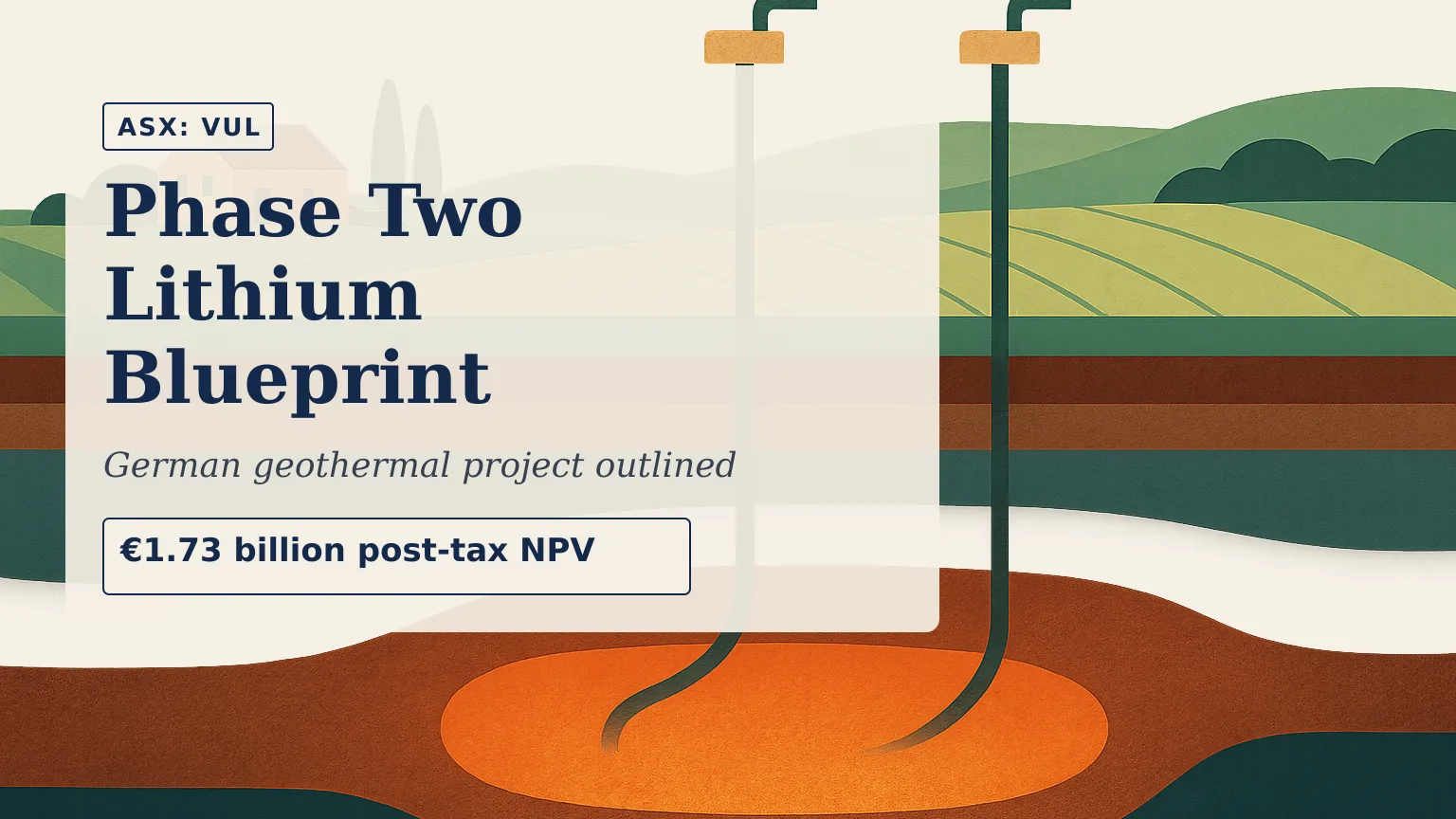
Vulcan Energy has outlined a €1.26 billion second-phase lithium and geothermal project in Germany. Project Ludwig’s PFS estimates a €1.73 billion post-tax NPV and 20.2% return.
Listen to article
0:00 / 3:23Vulcan Energy Resources has completed a preliminary feasibility study for Project Ludwig, its proposed second German lithium and geothermal development.
The project sits near Ludwigshafen, about 60 kilometres north of Vulcan’s first-phase Project Lionheart. Both developments target the Upper Rhine Valley Brine Field.
The study estimates a pre-tax NPV8 of €2.61 billion and an internal rate of return of 25%. After tax, those figures are €1.73 billion and 20.2%.
Those economics assume a 30-year operating life and a lithium carbonate price of €20,588 per tonne. The model is unlevered and assumes 100% equity funding, without financing costs.
Production and Cost Profile
Project Ludwig is designed to produce 21,100 tonnes of battery-grade lithium carbonate annually. Total planned output is about 517,000 tonnes over the project life.
The development would also generate 3,125 gigawatt-hours of renewable heat each year. Some heat would power Vulcan’s processing operations, while the balance could be sold externally.
Estimated C1 operating costs are €4,101 per tonne of lithium carbonate. Vulcan described this as a lowest-industry-quartile cost position.
Development capital is estimated at €1.26 billion in real 2026 terms. That figure includes a 15% contingency but excludes €126.1 million of owner’s costs and €63 million of closure costs.
Vulcan estimates capital intensity is about 15% below Lionheart on an equivalent lithium carbonate basis. However, the projects have different products, assumptions, effective valuation dates and development stages.
Managing Director and Chief Executive Officer Cris Moreno said: “Project Ludwig represents the strategic next step in our phased development of the Upper Rhine Valley Brine Field.”
“We’re applying the technical, operational and commercial blueprint of Lionheart to a second development area with similar resource and geological characteristics.”
Resource Base Expands
Indicated Mineral Resources across the Ludwig and Therese licences increased 91% to 1.25 million tonnes of lithium carbonate equivalent. Inferred resources rose 5% to 2.23 million tonnes.
The company also reported maiden geothermal resources of 193 petajoules Indicated and 295 petajoules Inferred.
The production target uses only Indicated lithium resources. No ore reserves or geothermal reserves have been estimated.
Importantly, Vulcan has not drilled a reservoir-depth well within the Project Ludwig area. The resource assessment uses seismic data, historical wells and analogue data from the wider brine field.
An appraisal well, additional seismic work and a definitive feasibility study remain ahead. These steps are intended to refine well locations, reservoir models and development costs.
Funding and Development Sequence
Vulcan has begun seeking strategic partners for minority project-level equity. It intends to retain majority control and later pursue asset-level project finance and public funding.
A final investment decision is planned only after Lionheart starts commercial production. The Ludwig study assumes that decision occurs in 2029.
That sequence keeps Lionheart’s construction and start-up ahead of Vulcan’s second development. It also means Ludwig’s timetable remains tied to successful delivery of the first phase.
Latest VULCAN ENERGY RESOURCES LIMITED ASX Announcements
- 15 Oct 2026 · 8:14 amCompany Update
- 9 Oct 2026 · 5:40 pmSubstantial Holders
- 22 Sept 2026 · 2:45 pmSubstantial Holders
- 21 Sept 2026 · 8:29 amCompany Update
- 14 Sept 2026 · 11:43 amDirector Interests
- 11 Sept 2026 · 8:18 amCompany Update
- 10 Sept 2026 · 8:21 amCompany Administration
- 10 Sept 2026 · 8:20 amFinancial Results
![[ASX: CAE] CANNINDAH RESOURCES LIMITED a diamond drill rig operating on rugged terrain at the Mt Cannindah exploration project in central Queensland,](/media/hero/6233c7ea-bcc3-4e6f-88c9-df0e823462a4/1791937391598-3848559c-640w.webp)
![[ASX: CCM] CADOUX LIMITED a close-up of unbranded cylindrical lithium-ion cells moving through an automated battery manufacturing line, with robotic equipment handling](/media/hero/351fae87-0e95-4e1b-a3f0-6191476cdaba/1791936952935-66cfba65-640w.webp)
![[ASX: BMR] BALLYMORE RESOURCES LIMITED a reverse-circulation drill rig operating beside the historic Torpy’s mine workings in rugged North Queensland bushland, framed](/media/hero/6ad1b10f-d45b-41fc-b020-abb09fd22410/1791861762377-a8dd9a7e-640w.webp)
![[ASX: FRI] FINBAR GROUP LIMITED a wide elevated view of the completed twin-tower Garden Towers development beside Queens Gardens, with the apartment](/media/hero/fa3e1003-44f7-4bd4-b22e-2350fa245c44/1791940379093-e4f9d193-640w.webp)
![[ASX: AKN] AUKING MINING LIMITED a wide aerial view of rugged western Greenland terrain near a fjord, showing exposed rock, low vegetation](/media/hero/2e4aafff-8a15-48b1-9bde-8efc451d3d8a/1791861149729-5d8804e3-640w.webp)
![[ASX: WHK] WHITEHAWK LIMITED a boardroom table with executives viewing an abstract digital risk dashboard on a large wall display, composed around](/media/hero/d1b2de93-4190-4774-b208-e82a2eb2aab6/1791858494002-ab272dc0-640w.webp)