ResourcesCompany Update
Zeotech (ASX: ZEO) Cuts Landfill Methane Emissions by 92% in Field Trial
Zeotech’s zeolite-treated landfill cells recorded average methane emissions 92% below untreated controls. The company is now considering longer monitoring and larger field trials.
Listen to article
0:00 / 3:14Zeotech Limited said its zeolite-treated landfill cells produced average methane emissions 92% below untreated controls during a Queensland field trial.
Griffith University confirmed the result in its final report on the six-month trial. Testing occurred at North Burnett Regional Council’s Mundubbera Waste Management Facility.
The outcome extends earlier simulated-landfill work, where a zeoteCH₄ biofilter reduced methane emissions by more than 90% against controls. Importantly, the latest trial tested the technology under live landfill conditions rather than a simulated environment.
How the Trial Worked
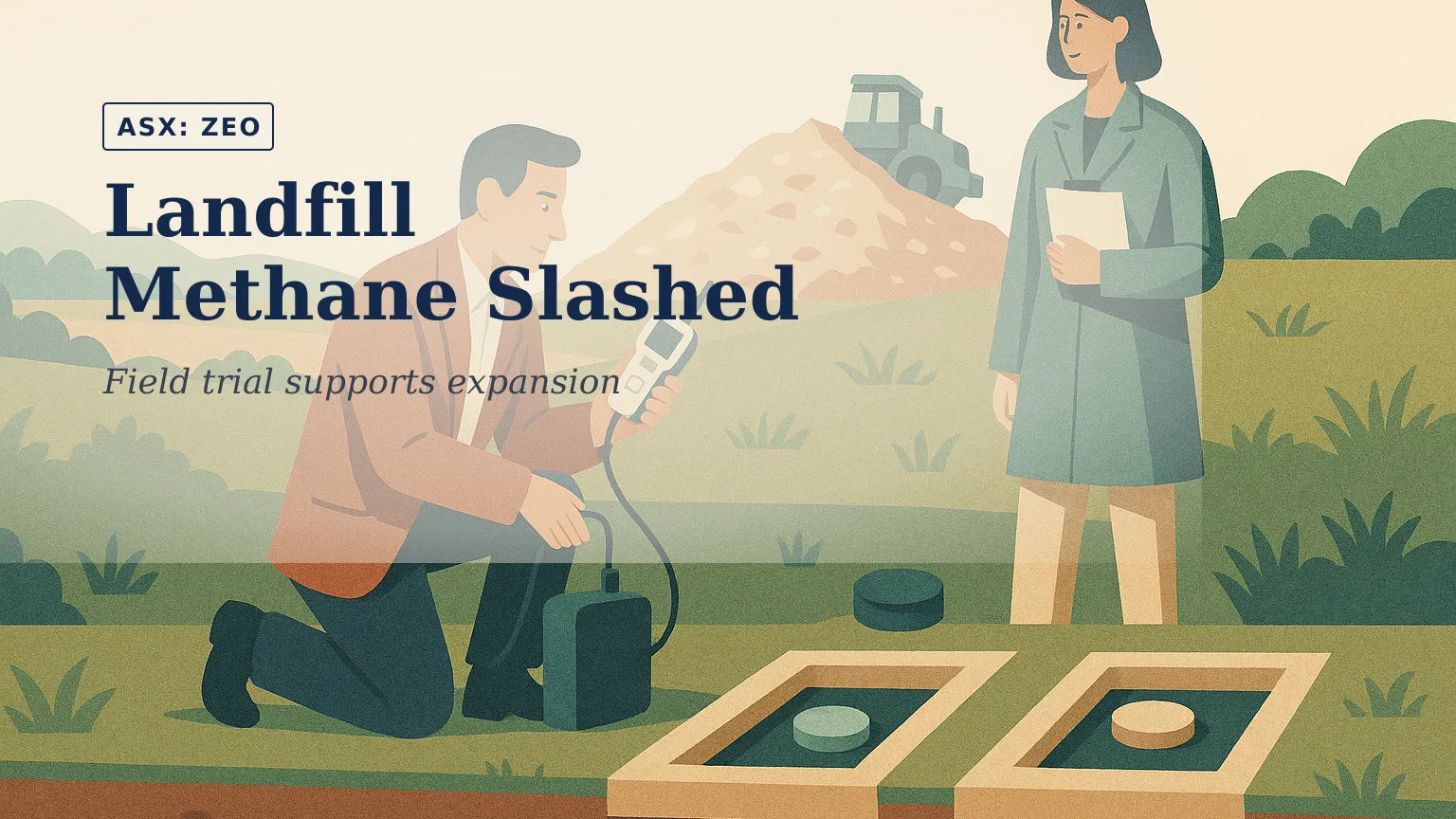
Griffith established eight test cells measuring two metres by two metres. Four contained inoculated zeolite within the landfill cover, while four untreated cells served as controls.
The selected area included low, medium and high-emitting zones. Static chambers and portable equipment measured methane and carbon dioxide fluxes between March and July 2026.
Methane emissions from treated cells remained substantially and consistently below those from control cells. Multiple readings also exceeded 97% methane elimination, according to Zeotech.
Griffith University researcher Dr Chris Pratt said: “The field trial has delivered very encouraging outcomes, with methane emissions from the zeolite-amended cells consistently and materially lower than the untreated controls across the monitoring period.”
Evidence Points to Oxidation
Gas analysis indicated methane was being eliminated through oxidation inside the treated cover layer. That distinction matters because lower surface readings could otherwise reflect temporary retention or delayed gas movement.
Methane-to-carbon dioxide ratio analysis supported the oxidation finding. Griffith calculated an apparent methane oxidation or reduction efficiency of approximately 85%, using the control ratio as its baseline.
However, the report acknowledged that landfill emissions vary naturally. Moisture, soil conditions, gas movement and seasonal changes can all affect measurements.
Field Conditions Expose Practical Issues
A significant rainfall event occurred shortly after installation. Two treated cells required repairs, although both continued recording low emissions after remediation.
The event highlighted requirements for erosion protection, moisture management and treatment-layer stability. Emissions also declined as conditions became cooler and drier during winter.
These factors support collecting data over warmer and wetter periods. Zeotech is considering extended monitoring, while the technology remains installed at the facility.
Commercialisation Requires More Field Work
Zeotech plans to use the results in discussions with landfill operators, waste-management organisations and other industry participants. It will seek further field trials, including potential larger-scale applications.
The technology is designed as a passive methane-control option within landfill cover systems. Zeotech is targeting sites that may be unsuitable for conventional engineered gas-capture infrastructure.
Meanwhile, the company is progressing its international patent application, “Zeolites for Methane Control.” The application covers ion-exchanged zeolites used for methane control and emissions mitigation.
A positive International Search Report considered all claims novel and inventive over the identified prior art. Zeotech is preparing to enter the national phase in selected jurisdictions.
Latest ZEOTECH LIMITED ASX Announcements
- 21 Sept 2026 · 7:20 pmCompany Administration
- 21 Sept 2026 · 7:19 pmFinancial Results
- 17 Sept 2026 · 9:31 amMeetings & Governance
- 25 Aug 2026 · 9:17 amCompany Update
- 13 Aug 2026 · 9:11 amCompany Update
- 24 July 2026 · 9:21 amQuarterly Reports
- 22 July 2026 · 9:22 amPresentations
- 13 July 2026 · 9:20 amCompany Update
![[ASX: MM1] MIDAS MINERALS LTD a close-up of freshly cut diamond drill core arranged in core trays, showing copper-silver mineralised sections alongside](/media/hero/fc708736-5ab0-4f94-a1b5-abdc58f72f90/1791264139527-f594ac5d-640w.webp)
![[ASX: GMN] GOLD MOUNTAIN LIMITED an elevated view across the historical Malhada do Angico mine area in northeast Brazil, showing narrow old](/media/hero/9941522c-8fc6-4836-9d3c-a3faa6669209/1791163933110-6606db6f-640w.webp)
![[ASX: VR8] VANADIUM RESOURCES LIMITED a large electric smelting furnace inside a heavy-industrial plant, with molten metal being tapped into a vessel](/media/hero/0a4c17fb-080c-4663-a616-5091b9cc158b/1791163787768-d72895c2-640w.webp)
![[ASX: SKK] STAKK LIMITED a smartphone held above a paper cheque during a mobile deposit, with the camera interface framing the cheque](/media/hero/1e2bf6f4-aaa9-4af9-9724-3a3cffbac645/1791337026539-c0f7e886-640w.webp)
![[ASX: SNT] SYNTARA LIMITED a clinician observing a clinical trial participant walking along a marked assessment path in a neurological examination room,](/media/hero/90bb9bfc-0b2a-4775-908d-ec1fad35eb0f/1791336817954-71a1eaf0-640w.webp)
![[ASX: WBT] WEEBIT NANO LTD a semiconductor engineer inspecting a silicon wafer inside a cleanroom, framed at workstation level with fabrication equipment](/media/hero/415698d0-9bb5-4f46-8575-ae4fe527a62a/1791336586549-37c6e747-640w.webp)