IndustrialsFinancial Results
DroneShield (ASX: DRO) Revenue Jumps 74% as Scaling Costs Drive Loss
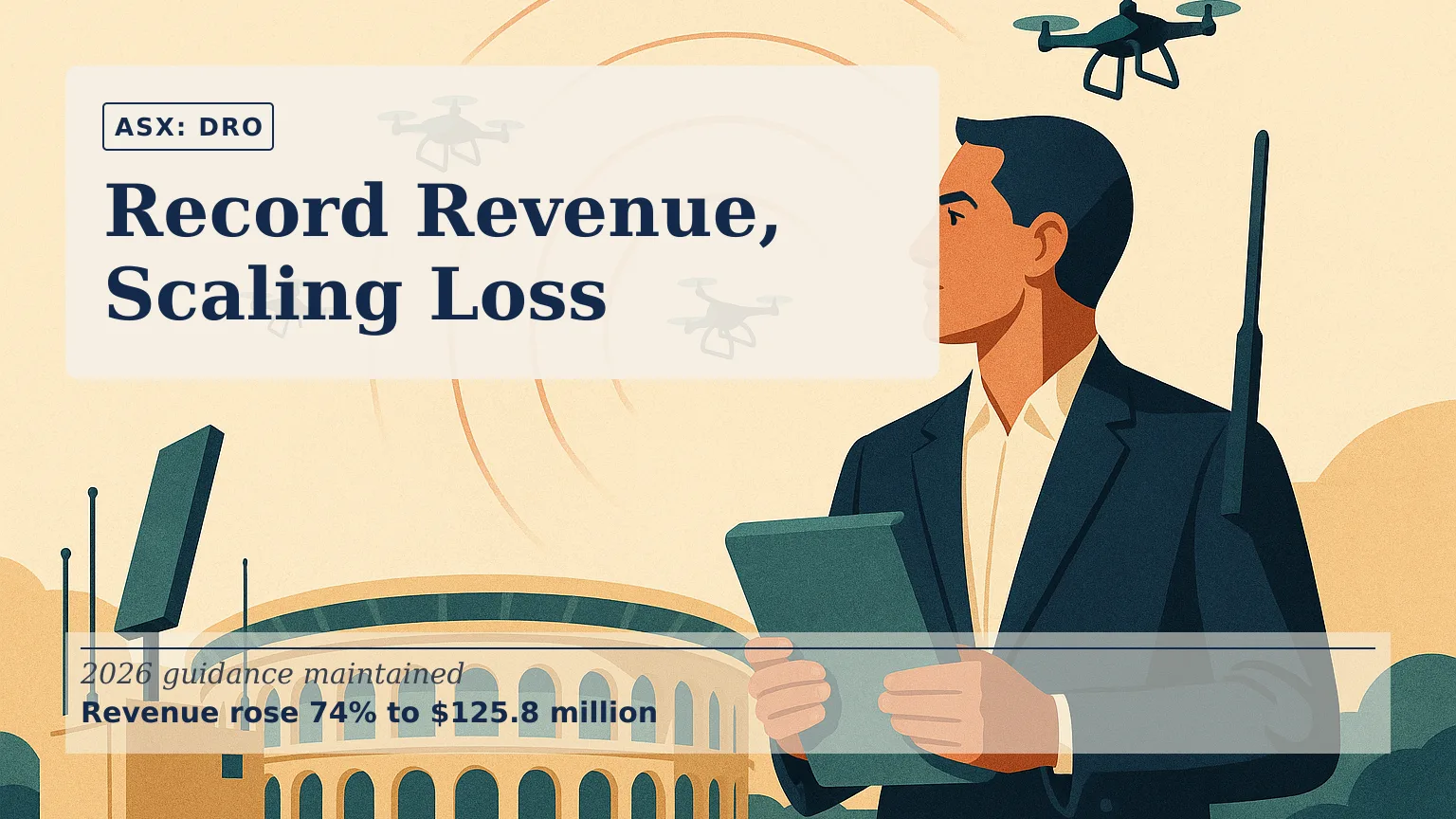
DroneShield’s first-half revenue rose 74% to a record $125.8 million. Planned scaling investment produced an underlying EBITDA loss, while 2026 guidance was maintained.
DRODRONESHIELD LIMITEDIndustrials2 min read
Listen to article
0:00 / 3:13DroneShield reported record first-half revenue as demand for counter-drone systems continued to grow, though heavy investment in production capacity, technology and management pushed the company into the red.
Revenue rose 74% to $125.8 million for the six months through June. Recurring revenue increased 229% to $11.5 million, supported by a global installed base of about 4,100 software-enabled devices.
The stronger top line was accompanied by a sharp deterioration in earnings. DroneShield recorded an underlying EBITDA loss of $12.4 million, compared with an $8 million profit a year earlier.
Its statutory loss after tax widened to $32.2 million from a $2.1 million profit, including $15 million of individually significant items.
Order Coverage Underpins Full-Year Guidance
DroneShield reaffirmed its 2026 revenue guidance of $250 million to $270 million, which would represent annual growth of between 15% and 25%.
Committed revenue stood at $240 million as of August 21, up from $176 million a year earlier.
That figure already covers roughly 89% to 96% of the company’s full-year revenue target and is equivalent to 111% of all revenue generated in 2025.
Committed revenue consists of confirmed orders scheduled for delivery at prevailing exchange rates, giving DroneShield relatively strong visibility over the remainder of the year.
A further $43 million is committed for 2027 and beyond across hardware, software, warranties and other services.
The immediate challenge is therefore less about winning enough work and more about converting that backlog efficiently while protecting margins.
Investment Weighs on Near-Term Profitability
DroneShield stepped up spending during the half across manufacturing, product development, operating systems and senior management.
The company also moved into a new 3,000-square-metre production facility and implemented new enterprise resource planning and sales systems as it prepares for a larger operating base.
Cash and term deposits stood at $180 million at June 30, down from $210.6 million at the end of December. DroneShield reported no debt.
Chief Executive Officer and Managing Director Angus Bean said the result showed the company was continuing to convert global demand into revenue growth.
Non-military government and commercial customers accounted for 15% of first-half revenue.
DroneShield also pointed to growing demand outside traditional defence markets. During the 2026 FIFA World Cup, the company supported seven multi-site drone-detection deployments in Kansas City, identifying 184 incidents and contributing to the seizure of 48 unauthorised drones.
New Products Move Into Production
DroneShield launched its RfAI-3 software engine and RfRecon hardware platform in July, with scaled RfRecon production expected to begin in the second half and initial deliveries targeted before year-end.
Further next-generation hardware releases are planned through 2027.
The company also produced its first European-manufactured hardware in June, adding regional manufacturing capacity as governments increasingly place importance on local supply chains and sovereign procurement.
That expansion could prove strategically important. Counter-drone procurement is increasingly shaped not only by capability and price, but also by where equipment is manufactured and how securely it can be supplied.
ASIC Investigation Remains an Overhang
Separately, DroneShield continues to assist the Australian Securities and Investments Commission with an investigation into ASX announcements and trading activity from November 2025.
The company said it remains unclear whether the investigation will result in any action.
For investors, the operational picture is increasingly defined by scale. DroneShield has substantial contracted revenue and a growing product portfolio, but its first-half loss shows the cost of building capacity ahead of demand.
The next test is whether that investment translates into stronger margins and cash generation as the existing order book is delivered.
Latest DRONESHIELD LIMITED ASX Announcements
- 8 Oct 2026 · 3:25 pmSubstantial Holders
- 6 Oct 2026 · 8:19 amCompany Administration
- 30 Sept 2026 · 8:49 amCompany Update
- 28 Sept 2026 · 8:28 amCompany Administration
- 23 Sept 2026 · 5:05 pmSecurities Administration
- 10 Sept 2026 · 9:05 amCompany Administration
- 4 Sept 2026 · 5:08 pmSubstantial Holders
- 1 Sept 2026 · 5:35 pmSubstantial Holders
![[ASX: ECT] ENVIRONMENTAL CLEAN TECHNOLOGIES LIMITED. a cutaway view of an industrial reactor sending an electrical pulse through layered precursor material, transforming](/media/hero/b96e60ce-00b9-4c1e-8b8a-5aecddc3a5f5/1789359955481-e0c2e745-640w.webp)
![[ASX: KTK] KTEK AEROSYSTEMS LTD a split-scene technical illustration showing an unmanned aircraft transitioning from translucent engineering geometry into a finished carbon-composite](/media/hero/4219f3ed-ab6b-4440-b373-36426cae5969/1788915134964-27f64ec8-640w.webp)

![[ASX: SKK] STAKK LIMITED a smartphone held above a paper cheque during a mobile deposit, with the camera interface framing the cheque](/media/hero/1e2bf6f4-aaa9-4af9-9724-3a3cffbac645/1791337026539-c0f7e886-640w.webp)
![[ASX: SNT] SYNTARA LIMITED a clinician observing a clinical trial participant walking along a marked assessment path in a neurological examination room,](/media/hero/90bb9bfc-0b2a-4775-908d-ec1fad35eb0f/1791336817954-71a1eaf0-640w.webp)
![[ASX: WBT] WEEBIT NANO LTD a semiconductor engineer inspecting a silicon wafer inside a cleanroom, framed at workstation level with fabrication equipment](/media/hero/415698d0-9bb5-4f46-8575-ae4fe527a62a/1791336586549-37c6e747-640w.webp)